.png)
Monday, November 17, 2025

Even in the coldest of temperatures, the all-new GLB offers a “Welcome home.” feeling

Icy cold and heavy snowfall during the final miles. Windscreen wipers and heating running at full blast to keep the view clear for the driver and the passengers warm. Anyone who enjoys skiing or snowboarding will appreciate how extreme these conditions can be. The engineers at Mercedes‑Benz also understand this because they are currently completing intensive cold-weather testing with the all-new GLB at the Mercedes Technology Center (MTC) in Sindelfingen, before its world premiere on 8 December 2025.
Whether as a spacious five-seater or a versatile seven-seater, this compact SUV is the perfect companion for trips to ski resorts or other wintry adventures. Beyond confident traction on snow-covered roads, what truly matters is supreme thermal comfort and clear visibility. To ensure the all‑new GLB meets Mercedes‑Benz’s exacting standards in these crucial areas – and delivers the hallmark quality customers expect – extensive testing in two, state-of-the-art climatic wind tunnels is essential.
Testing at the limit: Arctic temperatures and blizzards in the climatic chambers
The temperature range in the so-called cold tunnel basically extends from -40 to +40 degrees Celsius, this covers practically every conceivable weather condition in the real world and includes a generous buffer. Cutting-edge snow cannons allow snow production with a wide variety of snow types over a wide temperature range. Combined with the wind tunnel’s high-powered fan, Mercedes‑Benz can simulate fierce blizzards where snowflakes race towards the test vehicle at speeds of up to 200 km/h.
A great deal of complex technology is incorporated within Mercedes‑Benz’s two climatic wind tunnels. In each tunnel, a rolling road simulates the road surface. Powerful electric motors drive four rollers each, allowing 4MATIC models to be tested under realistic conditions. The test rigs are designed for a total output of up to 780 kW, enabling top speeds of up to 265 km/h. Vehicles can also be refuelled and charged within the tunnels. The building extends over a 70 x 60‑metre floor area. In addition to the two test rigs, it houses offices and a control room. From there, the technicians can regulate temperature, humidity, wind speed, and other parameters. Each test can be closely observed through large, fully insulated windows.
Quality enhancement in every season: simulating the desert sun
What if the destination isn’t St. Moritz, but St. Tropez? What if the goal is Lake Garda rather than the Grossglockner? It’s not just snow and ice that present challenges for a car and its occupants; heat and solar radiation have their own pitfalls. In the heat chamber, temperatures from -10 to +60 degrees Celsius can be generated. There is also a solar simulation system with 32 lamps, delivering a radiation spectrum that corresponds to natural sunlight. Over an 8 x 2.5‑metre area, the radiation intensity can be varied between 200 and 1,200 watts per square metre. The highest level is comparable to very intense sunshine, such as that found only in remote desert locations, such as Death Valley in the USA.
Another development tool in the heat tunnel is the so-called “Hot Road”. This is a simulated road surface where the temperature there can be continuously adjusted between +50 and +70 degrees Celsius, precisely replicating the thermal conditions of a road surface on a scorching summer day. The goal here, too, is to create conditions that are as close to reality as possible.
In the climatic wind tunnels, almost every weather condition can be simulated all year round – and with very low tolerances. Unlike tests on public roads, the measurements are reproducible at any time. The cold chamber helps Mercedes‑Benz to further close the gap between simulation and practical testing, and to continuously improve vehicle quality through even more comprehensive tests.
Snow flurries, icy windscreens: authentic winter testing
The engineers are using the testing possibilities of the climatic wind tunnels to examine a variety of vehicle components and functions. For example, they are examining the function of the windscreen wipers to ensure they work perfectly in all weather conditions. For example, in the cold tunnel, engineers check whether swirling snow can block the air intakes – a real-world risk caused by spray from passing trucks.
In frosty temperatures between -15 and -20 degrees Celsius, the heating system must demonstrate that it can defrost an icy windscreen quickly. A camera records the entire de-icing process. The all-new GLB also passed these tests impressively. At an outside temperature of -15 degrees Celsius, it takes only 15 minutes for the windscreen to be so clear that it would be possible to drive off. And this only with the help of the defrost setting of the heating system and without further intervention from the driver, such as switching on the windscreen wipers.
A welcoming climate: from the moment the occupants step inside
The new Mercedes‑Benz GLB raises efficiency and climate comfort to a new level. One example: on a 20‑minute drive at an outside temperature of -7 degrees Celsius, it heats the interior twice as fast as its predecessor – and even undercuts the heating time of a conventionally powered model. Compared to its predecessor, the all‑new electric GLB requires only about half the energy. The latter has a positive effect on the electric range.
The heating process starts automatically as soon as someone gets into the car. Mercedes‑Benz’s strategy is to first warm the upper body and hands. This ensures rapid thermal comfort, even without using pre-conditioning. In addition, the system is now even more intuitive and comfortable to use and can be adapted to individual needs in many ways. Regardless of whether the occupants are charging, sitting in the vehicle or even taking a nap, the system regulates heating and cooling seamlessly with the help of its intelligent, predictive operating strategy.
Central to this system is an innovative heat pump that has been adapted from the VISION EQXX technology programme. As a so-called multi-source model, it can use three energy sources in parallel: the waste heat from the electric drive and the battery, as well as the ambient air. By using this “free” heat, the heat pump contributes to the high efficiency of the GLB. It manages this process with around a third of the electrical energy that a comparable auxiliary heater would require for the same output.
Welcome home: Redefining comfort in the compact SUV segment
Instead of the previous sculptural design, a purist concept with a focus on a individual iconic, high-tech elements takes its place. The design is reduced to the essentials and conveys a state-of-the-art, elegant ambience. A highlight of the interior is the optional, floating MBUX Superscreen, which extends over the entire width of the dashboard.
The circular air vents at either end of the MBUX Superscreen have a sporty and futuristic effect. The outer rings, finished in Silver Shadow, appear to float in front of a funnel-shaped form. The centre nozzle replaces the usual louvres with a flat, state-of-the-art body. Another highlight are the doors with a concave main body that recedes into the background and generously dimensioned, floating centre panels with an open storage compartment. The pull handle with a classic tube-like design looks straightforward, but powerful and sporty.
The floating centre console rounds off the design. It connects stylishly under the MBUX Superscreen and offers a large, three-dimensional trim surface, which is available in various luxurious designs. The trim integrates a smartphone storage compartment with wireless charging (optional) and cup holders in an aesthetic form.
The new steering wheel is designed to be even more ergonomic and is more intuitive to operate. In response to numerous customer requests, Mercedes‑Benz has reintroduced a rocker switch for the limiter and DISTRONIC, as well as a roller switch for volume control.
A more spacious and flexible interior
The all-new GLB is available as a five- and seven-seater. It adapts effortlessly to a wide range of requirements and has plenty of space for family, friends, and spontaneous plans. Compared to its predecessor, the new GLB offers noticeably more headroom in the first two rows of seats. This is due to the roofline of the SUV as well as the standard panoramic roof. The seating comfort in the second row has been noticeably improved with more legroom and longer thigh support.
A longitudinally adjustable rear seating row is optionally available for the five-seater and standard for the seven-seater. With this function, the backrests of the second row can be adjusted in several angles, and the entire row of seats can be moved longitudinally. This allows either the comfort for the passengers to be maximised, or the boot volume to be increased.
The optional third row of seats is easier to get into than in the predecessor. This is due, among other things, to the significantly longer adjustment range of the Easy‑Entry function. If seats six and seven are not needed, the third row of seats can be sunk into the load floor.
Switchable panoramic sunroof with illuminated star pattern
The large panoramic roof sets a new standard in the segment and provides an exceptionally generous and open sense of space. To protect against solar radiation, it consists of heat-insulating laminated safety glass with an infrared-reflecting coating and a low-emissivity (LowE) coating on the inside. This reduces heating of the vehicle interior in summer.
In winter, the LowE coating reduces heat loss by reflecting the interior heat back into the cabin. At only 200 nanometres, this infrared film is thinner than a human hair, which has a diameter of approximately 50,000 nanometres.
As an option, the transparency of the panoramic roof can be changed segment by segment in 10 to 20 milliseconds. Passengers can choose between transparent for a clear view upwards and opal (milky) for more privacy. The opal (milky) state not only protects against prying eyes from the outside but also offers improved glare protection in direct sunlight. It is operated via a corresponding menu in the vehicle settings in the central display.
For the ultimate touch of style, the large panoramic roof is optional even illuminated. Each one connected to the ambient lighting setting for a personalised and luminous starry sky. The light is fed in via LED modules from the front.
MB.OS: Creating an intuitive and user-friendly digital experience
The Mercedes-Benz Operating System (MB.OS) superbrain transforms the all‑new GLB into an intelligent companion that thinks, learns and evolves with its driver. Combined with the fourth MBUX generation, the very latest operating concept delivers redesigned welcome animations, the advanced Zero Layer function, an extensive range of apps, the MBUX Virtual Assistant with various emotionally responsive avatars and powered by generative artificial intelligence, navigation with Google Maps and powerful 3D MBUX Surround Navigation.
Moreover, MB.OS enables the latest assistance systems. The all-new GLB has a comprehensive range of driver assistance systems, including DISTRONIC distance control as standard in Europe. The hardware comprises eight cameras, five radar sensors, 12 ultrasonic sensors and a water-cooled high-performance computer with sufficient power reserves for future functions and regular over-the-air updates. Mercedes‑Benz bundles all assistance systems under the name MB.DRIVE. As digital extras[1], they are either already available at market launch or planned and can be updated later.
[1] To use the digital extras, customers must create a Mercedes me ID and agree to the terms of use for digital extras and the Mercedes me ID terms of use in their currently valid versions. In addition, the respective vehicle must be linked to the user account. After the limited term has expired, the digital extras can be extended for a fee, provided that they are still offered for the corresponding vehicle.


Tuesday, January 7, 2025
If you're looking for a new vehicle, we've got you covered with this beautiful 2025 Mercedes-Benz GLE 350! Alpine Grey Exterior, Black Interior, 9-Speed Automatic Transmission, 4MATIC Drive and 2.0L I4 Turbocharged Engine! Key Features include Navigation system, Parking sensors, Automatic temperature control, Exterior parking camera front, Emergency communication system, Exterior parking camera left, Power moonroof, Exterior parking camera right, Premium audio system, Exterior parking camera rear, Wireless phone connectivity and Front dual zone A/C. Come into Mercedes-Benz of Huntsville and check out this beautiful SUV today! #MercedesBenzofHuntsville #MercedesBenzGLE350

Monday, April 22, 2024
NOW HIRING

The Best of the Best
MERCEDES-BENZ!
First Class Reputation
Wouldn't you love to be able to describe your place of work with those amazing words?
As a New Car Executive Sales Associate, you will assist clients by meeting and exceeding their expectations during their buying experience as they achieve their dream of owning a luxury vehicle from Mercedes-Benz of Huntsville, AL
What's in it for YOU?
• Pay plan with excellent earning potential
• Experienced management team
• Full Benefits package
• Continual training to keep you at the top of your game
• Marketing team on-site
What YOU will do as a New Car Sales Executive:
•Understand that business is built on Customer Satisfaction and devote yourself to ensuring these standards are continuously met
•Determine each Customer's needs by utilizing the Customer Needs Analysis Process
•Select, Present, and Demonstrate vehicles per the Vehicle Selection, Presentation, and Demonstration Process
•Seek Customer Agreement to purchase/lease a new vehicle per the Customer Agreement Process
•Encourage repeat and referral business as well as customer satisfaction by utilizing our Client Relation Management (CRM) tool
•Deliver new vehicles per the established Vehicle Delivery Process
•Introduce and Educate the buyer to the Dealership Service and Parts Department to ensure they continue to return with all of their service needs
•Clearly understand vehicle equity, values, and trade-in options and be able to explain to Customers
•Understand all applicable Federal, State, and Local laws governing the sales or lease of a vehicle
•Attend all Sales Meetings
•Partner with the Sales Manager to establish, work towards, and meet all objectives and expectations set as a member of the New Car Sales Team
Qualifications
You will be given the tools, training, and strategies to succeed as a New Car Executive Sales Associate. To get started we are looking for someone with the following Qualifications:
• 3 years of sales experience in a Luxury Automotive retail environment preferred
• High School Diploma or equivalent
• Ability to understand written, electronic, and verbal communication
• Professionalism, Organization, and Customer Relationship building skills
• Valid in-state driver's license
Monday, April 1, 2024
Mercedes GLC EV will arrive in 2026 as a successor to the Mercedes EQC
The electric equivalent of the Mercedes GLC will replace from 2026 the Mercedes EQC, which went out of production last year.
The EQC was not the first electric model from Mercedes because there was the Mercedes B-Class Electric Drive, also known as the Mercedes B 250e, in 2015, which competed at that time with the BMW i3.

Launched in the fall of 2019, the Mercedes EQC was the first Mercedes electric model with the particle EQ in its name. However, the name was a bit confusing because the Mercedes EQC didn’t stand for the electric version of the C-Class limousine but the GLC SUV.
Mercedes rushed to launch an electric SUV before BMW, which introduced the iX3 at the end of 2020, but the Mercedes EQC was a model with many compromises. It was based on the GLC’s platform from which it took over the front and rear axles and interior but could not be configured with air suspension because there was not enough room due to the large 80 kWh battery. The soft suspension offered a lot of comfort but in corners, it had significant roll due to the large 2.5-ton weight. In contrast, the 80 kWh battery gave it a decent real range of around 335 km. But the 76,000 euros price tag was pretty steep even for a premium SUV.
At the end of summer 2023, the Mercedes EQC was taken out of production due to poor sales and since then several rumors have emerged about its successor. There was a rumor that its successor might use the MMA multi-drive platform intended for the future compact range (the first model will be the CLA in 2025) or that it might take over the EVAII platform from the EQE/EQS.
MB.EA platform as a a base for the Mercedes GLC EV
In the end, Mercedes chose another solution. The MMA platform developed as “Electric First”, but also supporting conventional engines, will be kept exclusively for the future compact range (CLA, CLA Shooting Brake, GLA/EQA, GLB/EQB), while the EVAII platform will be upgraded, and will continue to be used only in the EQE/EQS luxury models.
The successor to the EQC, which will probably be called the Mercedes GLC EV or GLC Electric as Mercedes will drop the EQ particle from the names of its electric models, will use the future MB.EA architecture is intended for future electric models in the mid-range class and above. We learned that the next generation EQE/EQS will also use the MB.EA platform after the end of the life cycle of the current generation.
Unlike the GLC, the Mercedes GLC EV will be a little smaller, will be less tall, and have a wider rear pillar and an SUV-coupe silhouette. The mirrors are door-mounted, and the exterior door handles will be hidden in the bodywork for aerodynamic reasons. From the first photos circulating on the internet, the headlights will not have the new CLA Concept light signature that Mercedes wants to use on the upcoming AMG GT 4-door electric coupe but will be classic. We believe that a final decision has not been made yet as Mercedes has announced that it will use the new light signature reproducing the Mercedes logo from the CLA Concept on other models in the future.
The wheel arch guards and sills accentuate the SUV look, while the chrome radiator grille will be closed and incorporate the Mercedes logo.
There’s no word yet on the MB.EA platform’s engines or batteries, but we do know that the MB.EA platform is based on 800V technology, and Mercedes will use EQXX’s new eATS 2.0 powertrain, silicon carbide inverter, and two-speed gearbox. The Mercedes GLC EV will come in versions with one rear axle motor or two motors, and there will also be AMG versions that will benefit from Yasa axial-flow motors.
We can estimate that the top version of the Mercedes GLC EV will have a battery similar to the future facelifted EQE, which will grow to around 96 kWh), while the base battery will have around 80 kWh, and the WLTP range will be between 500 and 600 km. The power spectrum will range from around 250 PS for the single-engine, to 400 PS for the two motors versions, with AMG versions expected to have between 500 and over 600 PS (AMG GLC 63 EV).
Visit Mercedes-Benz of Huntsville at 6520 University Dr in Huntsville, AL 35806 or call them at (256) 776-7629 today!
Pre-Owned 2018 Mercedes-Benz CLA CLA 250
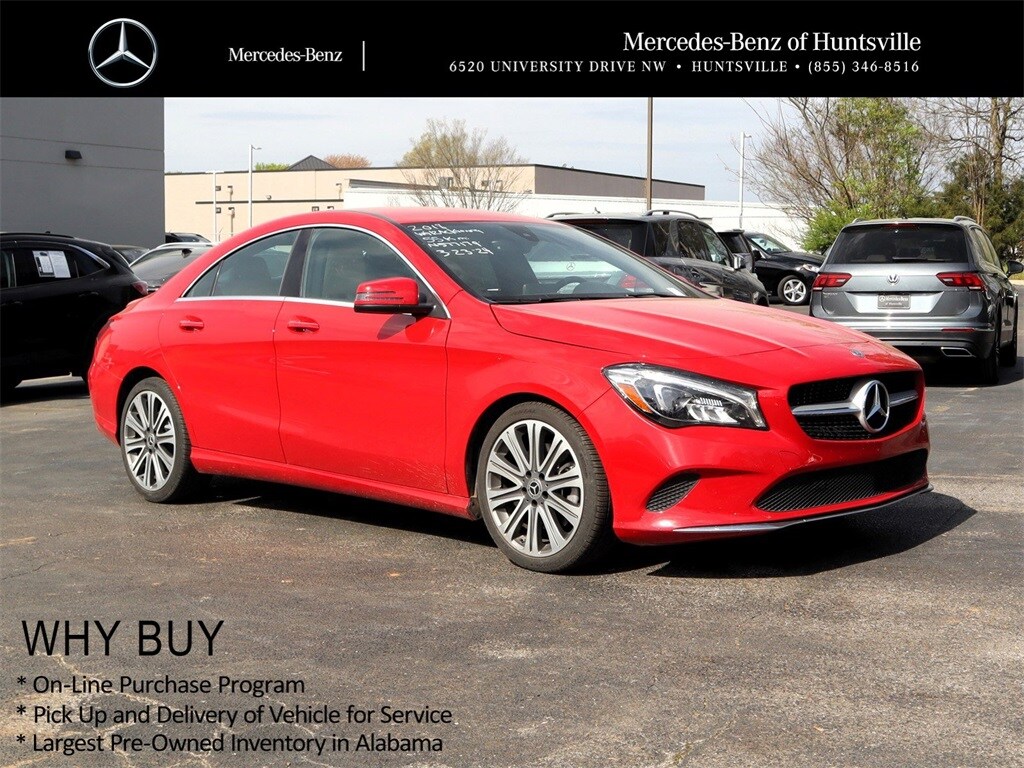
This vehicle is nicely equipped with. 2.0L I4 Turbocharged 7 Speed Dual Clutch DCT FWD
It's Easy!!!
Odometer is 11893 miles below market average! 24/37 City/Highway MPG
Awards:
* ALG Residual Value Awards, Residual Value Awards
It's Easy!!!
Odometer is 11893 miles below market average! 24/37 City/Highway MPG
Awards:
* ALG Residual Value Awards, Residual Value Awards
https://www.mbhsv.com/used/Mercedes-Benz/2018-Mercedes-Benz-CLA-65953507ac180569b910e4ad0beb0f68.htm
Base MSRP excludes transportation and handling charges, destination charges, taxes, title, registration, preparation and documentary fees, tags, labor and installation charges, insurance, and optional equipment, products, packages and accessories. Options, model availability and actual dealer price may vary. See dealer for details, costs and terms.
AMG® and 4MATIC® are registered trademarks of Mercedes-Benz Group AG.
Android Auto™ is a trademark of Google LLC.
Apple CarPlay® is a registered trademark of Apple Inc.
harman/kardon® and Logic 7 are registered marks of Harman International Industries, Incorporated
Burmester® is a registered trademark of Burmester Audiosysteme GmbH, Berlin, Germany
Bluetooth® is a registered mark of Bluetooth SIG, Inc.
AMG® and 4MATIC® are registered trademarks of Mercedes-Benz Group AG.
Android Auto™ is a trademark of Google LLC.
Apple CarPlay® is a registered trademark of Apple Inc.
harman/kardon® and Logic 7 are registered marks of Harman International Industries, Incorporated
Burmester® is a registered trademark of Burmester Audiosysteme GmbH, Berlin, Germany
Bluetooth® is a registered mark of Bluetooth SIG, Inc.
Subscribe to:
Comments (Atom)